
Who can do what
Open Procedures
Procedures is in the Lab operations group of the left-hand navigation. The page opens on the Protocols tab, with a Policies tab beside it; the search box (Search protocols… or Search policies…) and the + button follow the active tab. Above the protocols table, one chip per tag filters the list. An organization with more than one site also gets a site selector (All sites) while the header is showing every site. With nothing to show yet, the tab reads No protocols or No policies.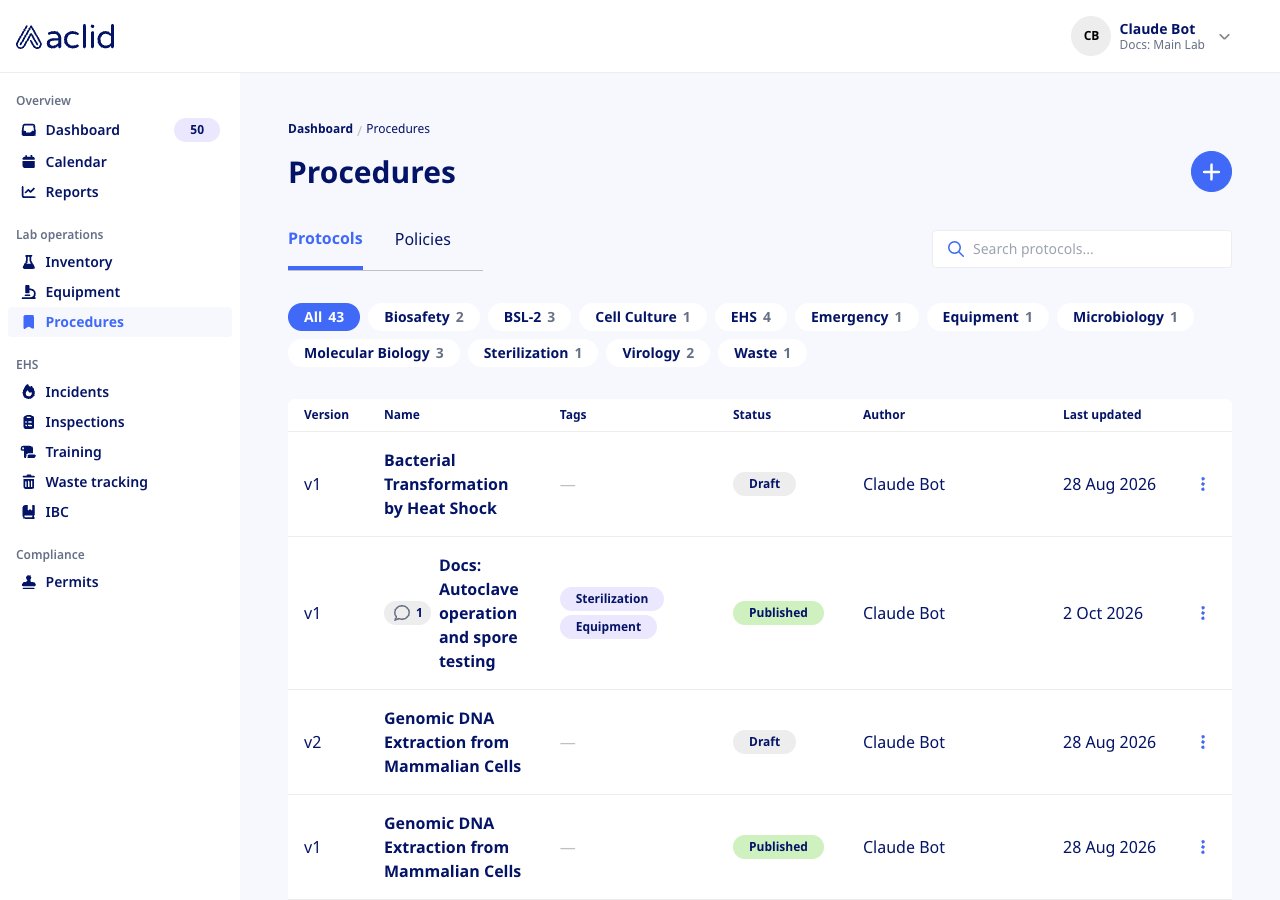
The Protocols tab, with tag chips and one open comment on a protocol
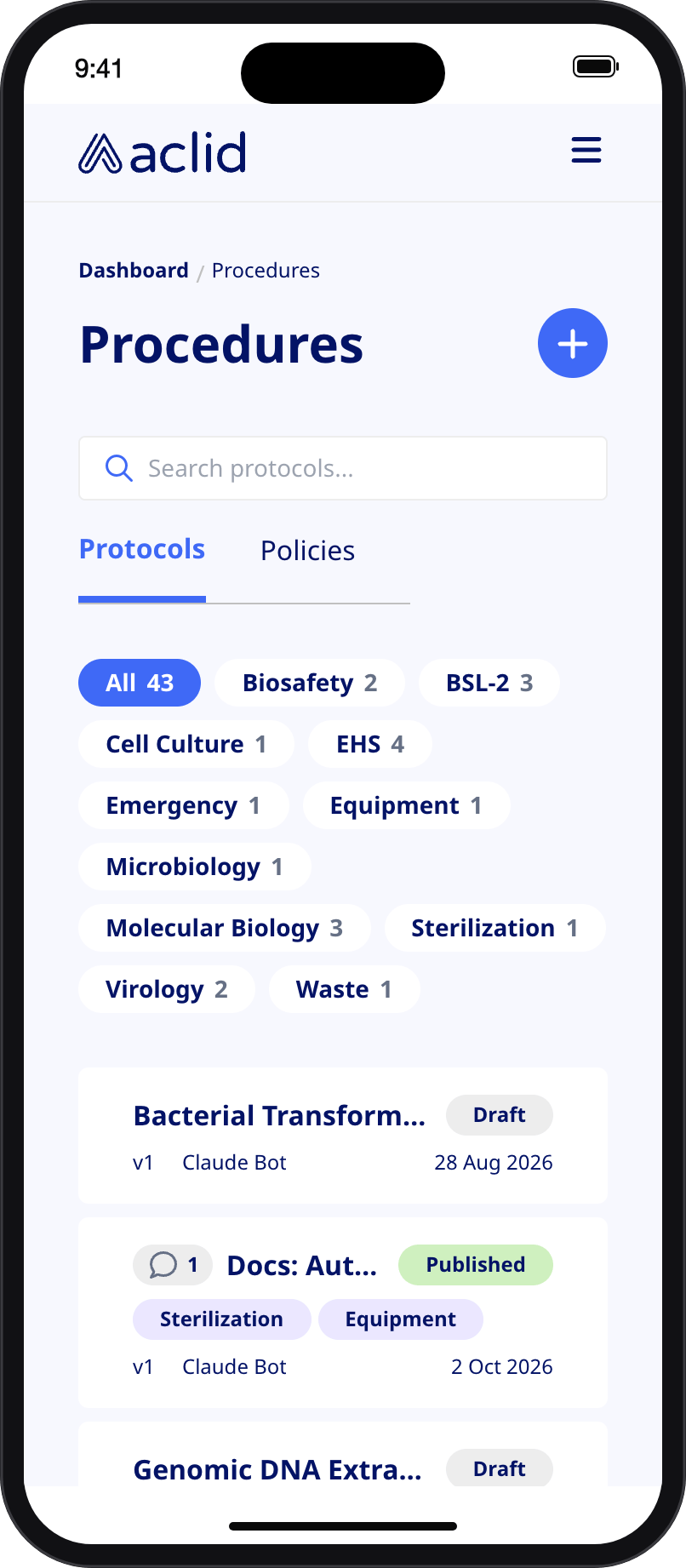
The same list on a phone
Key concepts
- Version: every protocol and policy carries a version number, starting at 1. A protocol’s versions are listed in a picker on its page as Version 1 (current), Version 2 (draft) and so on.
- Draft: the one editable version of a protocol. Only admins see it, and only one draft can exist at a time. Its page carries a You’re viewing a working draft banner and the badge Draft last updated with the date.
- Published: a frozen version that everyone can read. The latest published version is the one the list opens; older ones show Previous versions can’t be edited.
- Overview, Materials, Safety, Procedure: the four parts of a protocol. The overview is a description plus Quick tip boxes; materials come from a catalog shared by all protocols, each typed Biological, Chemical, Consumable or Equipment; safety holds Personal protection, Disposal notes and Hazards; the procedure is the ordered Steps (a Title and formatted Details) and the Files attached to the version.
- Comments: review threads on the Overview, Materials or Safety section or on one step. Open threads are counted in a speech-bubble badge on the list and on each tab; resolved threads are hidden until you click Show resolved.
- Policy: a name, a description, a Policy author and one PDF in the Policy card. Its badge reads Published or, for a draft, Updated with the date.
- Site access: the sites a protocol or policy applies to. All sites means no restriction.
Tasks
Create a protocol
Admins only.
- On the Protocols tab, click the + button. The Create protocol modal opens.
- Enter a Name, and optionally a Description (Optional) and Tags (optional). Type a new tag to add it to the organization’s list.
- In a multi-site organization, set Site access: one or more sites, or All.
- Click Create. The new protocol opens as Version 1, a draft: the Materials and Safety tabs read Not added, and the Procedure tab offers Add first step or Upload a file.
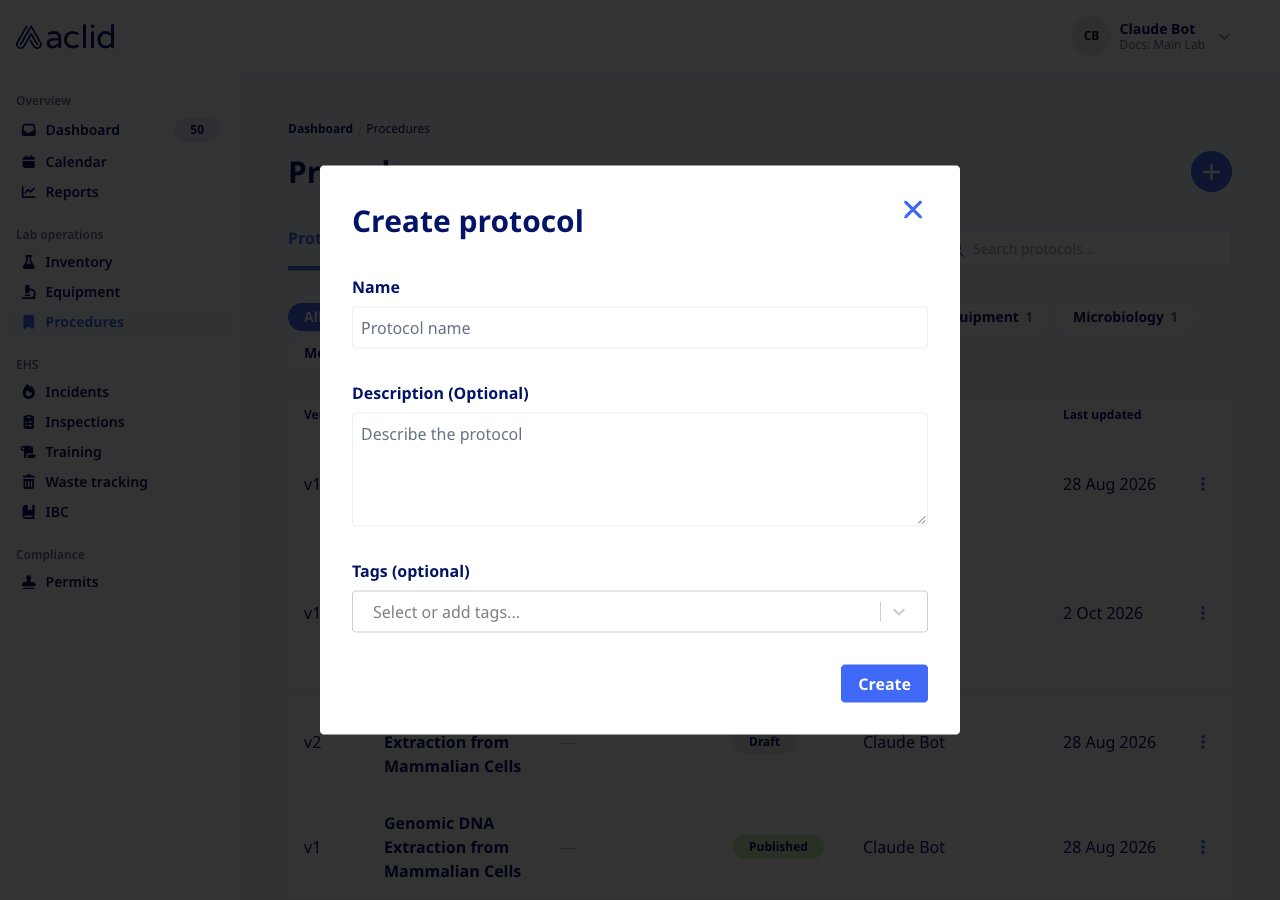
The Create protocol modal
Fill in the overview and materials
Admins only, on a draft.
- In the Overview card click Edit to change the description and, under Quick tips, click Add tip for each tip. Update at the top of the page changes the Name, Author and tags.
- On the Materials tab click Add material. Pick an existing material from Search or create a material…, or type a new name and choose its Type.
- The Action menu on a material row offers Edit, which renames the catalog entry everywhere it is used, and Remove, which takes it off this protocol only.
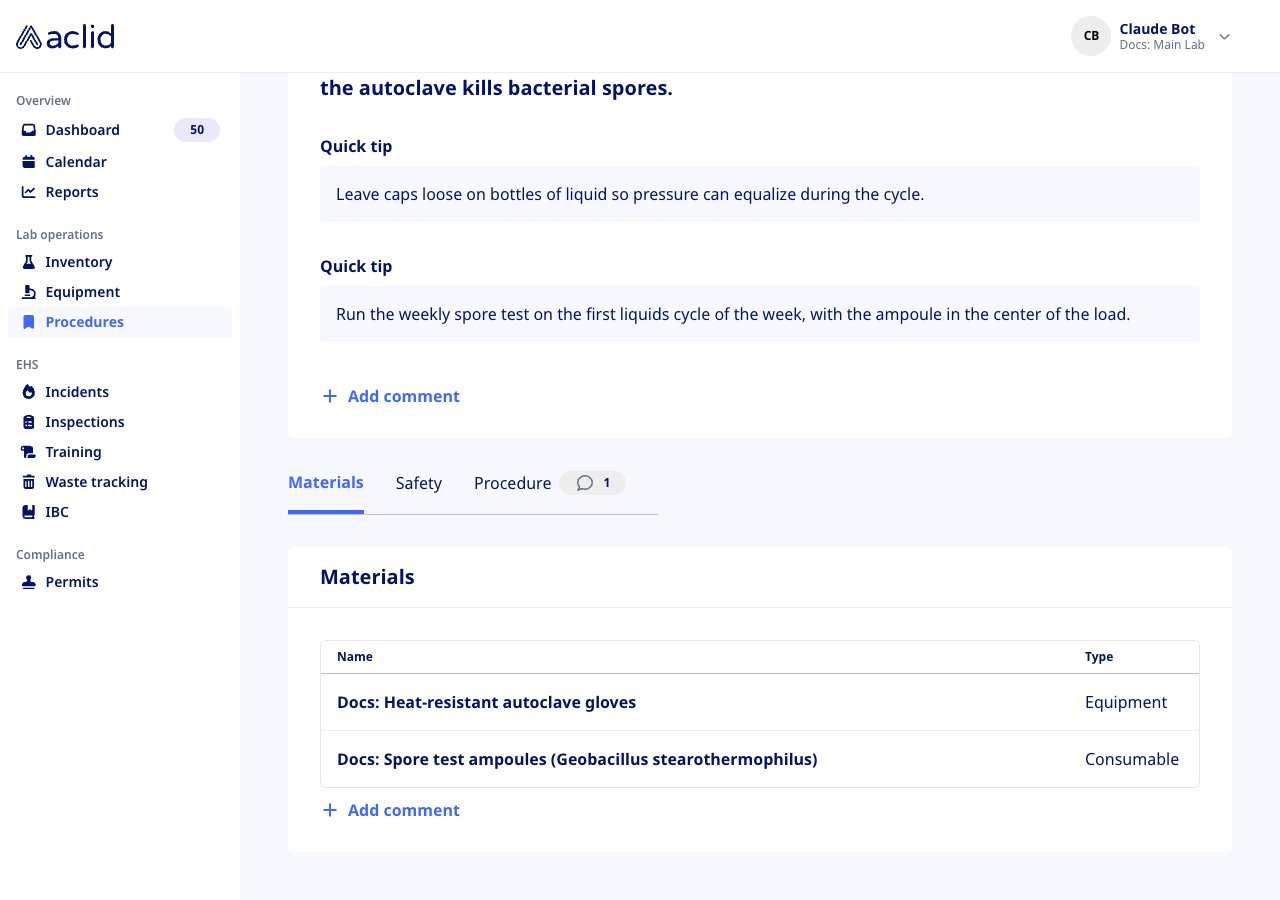
The Materials tab of a published protocol
Write the safety notes
Admins only, on a draft.
- On the Safety tab click Edit.
- The Edit safety modal has Personal protection, Disposal notes and Hazards. Fill in the ones that apply and click Save; only the notes you fill in are shown, and a tab with none reads Not added.
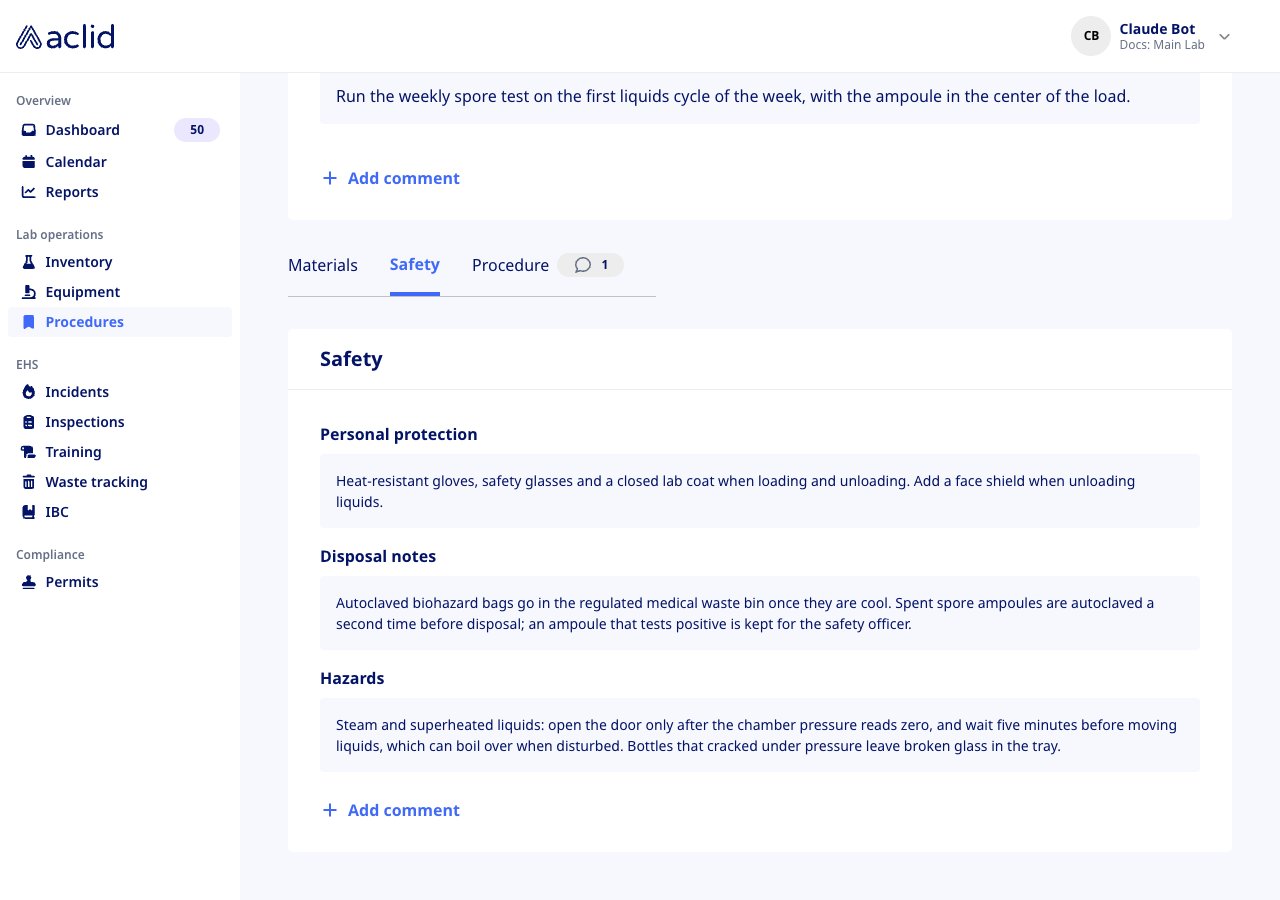
The Safety tab
Add the steps and files
Admins only, on a draft.
- On the Procedure tab, in the Steps card, click Add step. Give the New step a Title and the Details, which accept formatted text and pasted images, then click Save.
- Each step has Edit and Delete. With more than one step, Re-order steps lets you drag them by the handle; click Done to keep the new order.
- In the Files card click Upload file, optionally set a File name (optional), and drop a PDF, Word document, video or spreadsheet. PDFs, Word documents and videos open inline when you click the file; every file has a download icon, and on a draft a bin icon removes it.
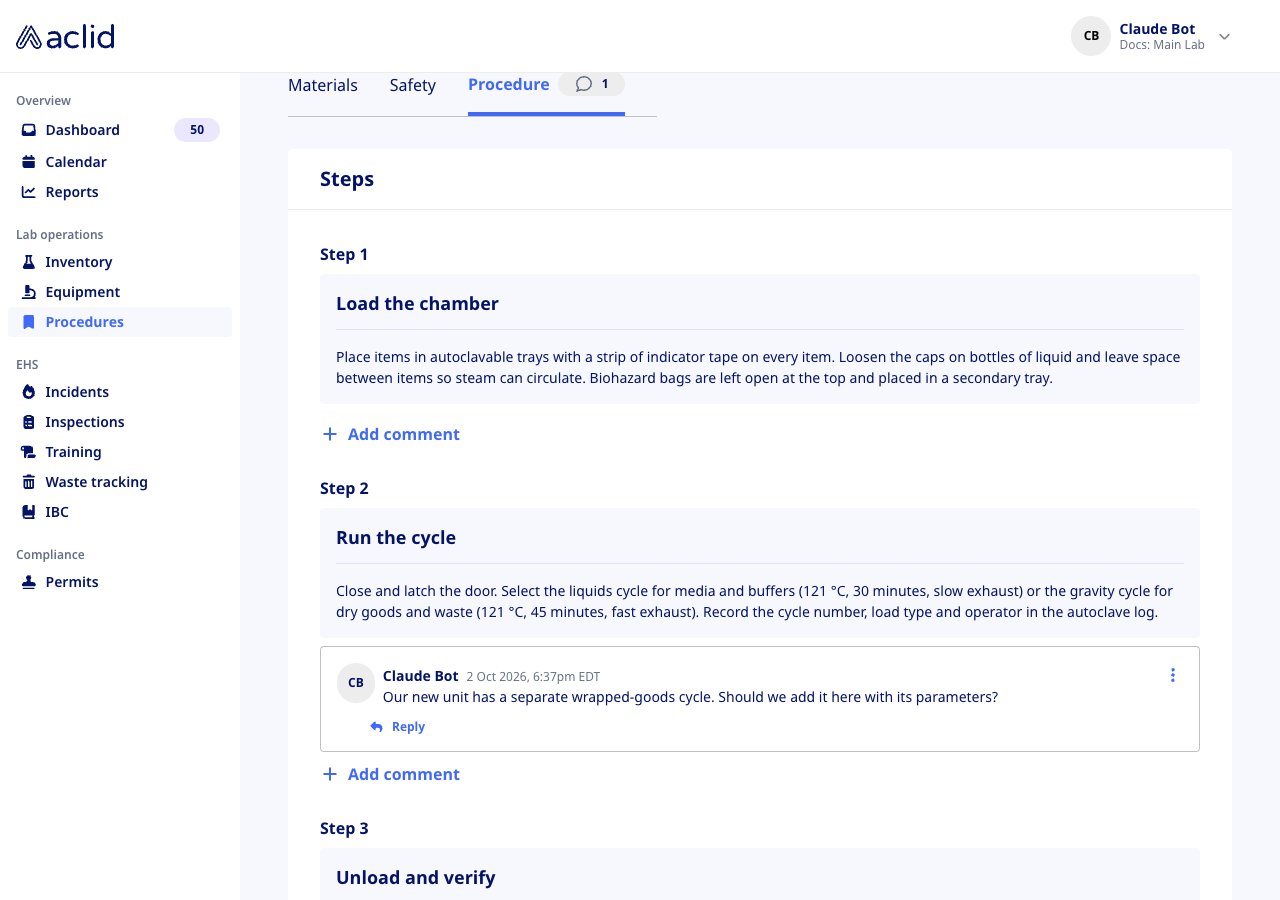
The Procedure tab, with the steps in order
Publish, and start the next version
Admins only.
- On the draft click Publish. A banner confirms Version N of this protocol has been published, the badge turns to Published with the date, and members can now open it.
- To change a published protocol click New draft. The draft copies the current version and opens with the working-draft banner; while it exists, the published page shows Edit vN draft instead.
- Use the version picker to read an earlier version. The download icon on a published version prints it.
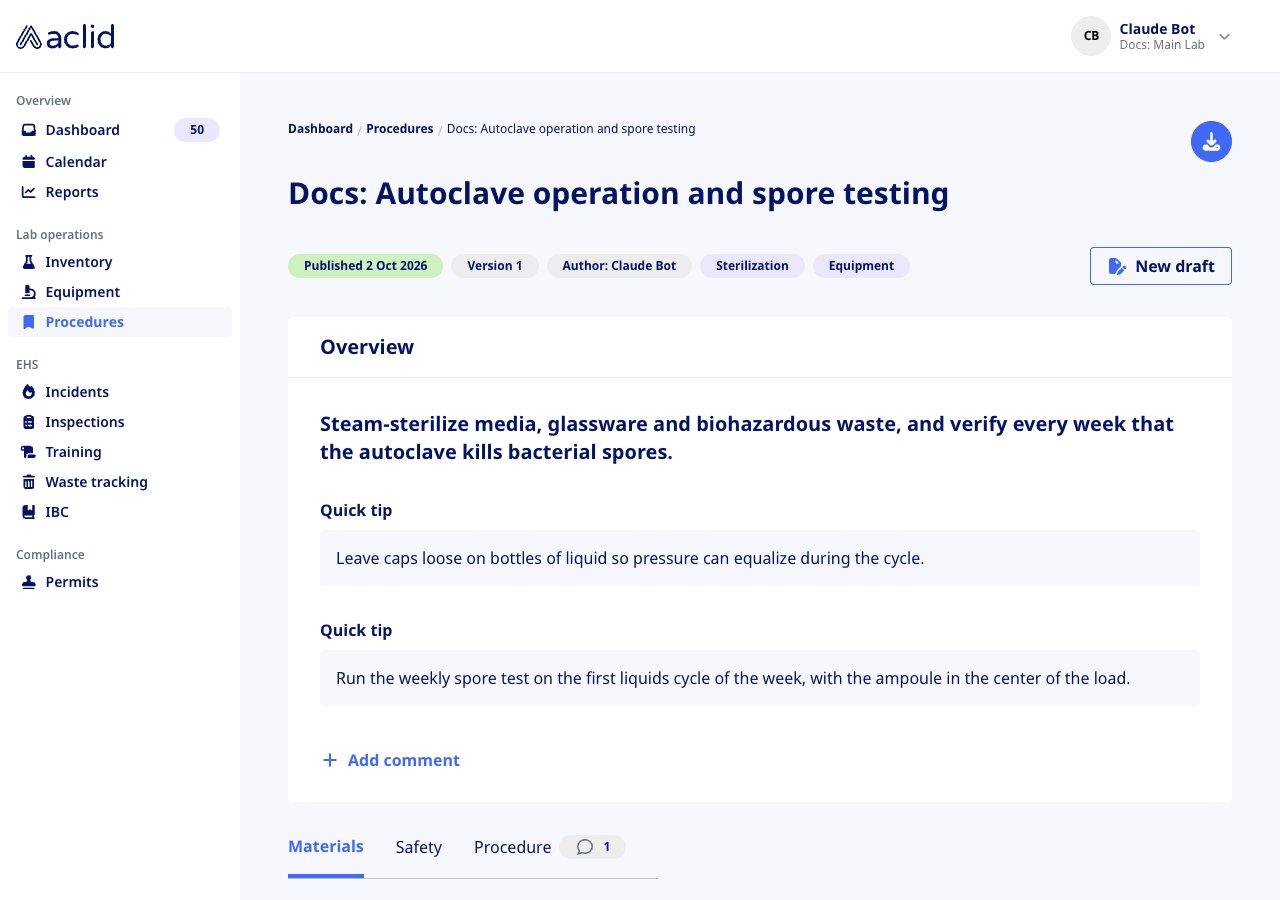
The latest published version, with New draft available
Comment on a protocol and resolve the thread
- Click Add comment under the Overview, Materials or Safety card, or under a step, write the note and click Comment. Anyone can comment on the versions they can see.
- Reply continues the thread. The menu on a comment offers Edit to its author and Delete to its author or any admin; deleting asks Delete this comment? and removes the replies too.
- The protocol’s author sees Resolve on the first comment of a thread. A resolved thread shows a Resolved mark, drops out of the counts and is hidden behind Show resolved (n); Reopen brings it back.
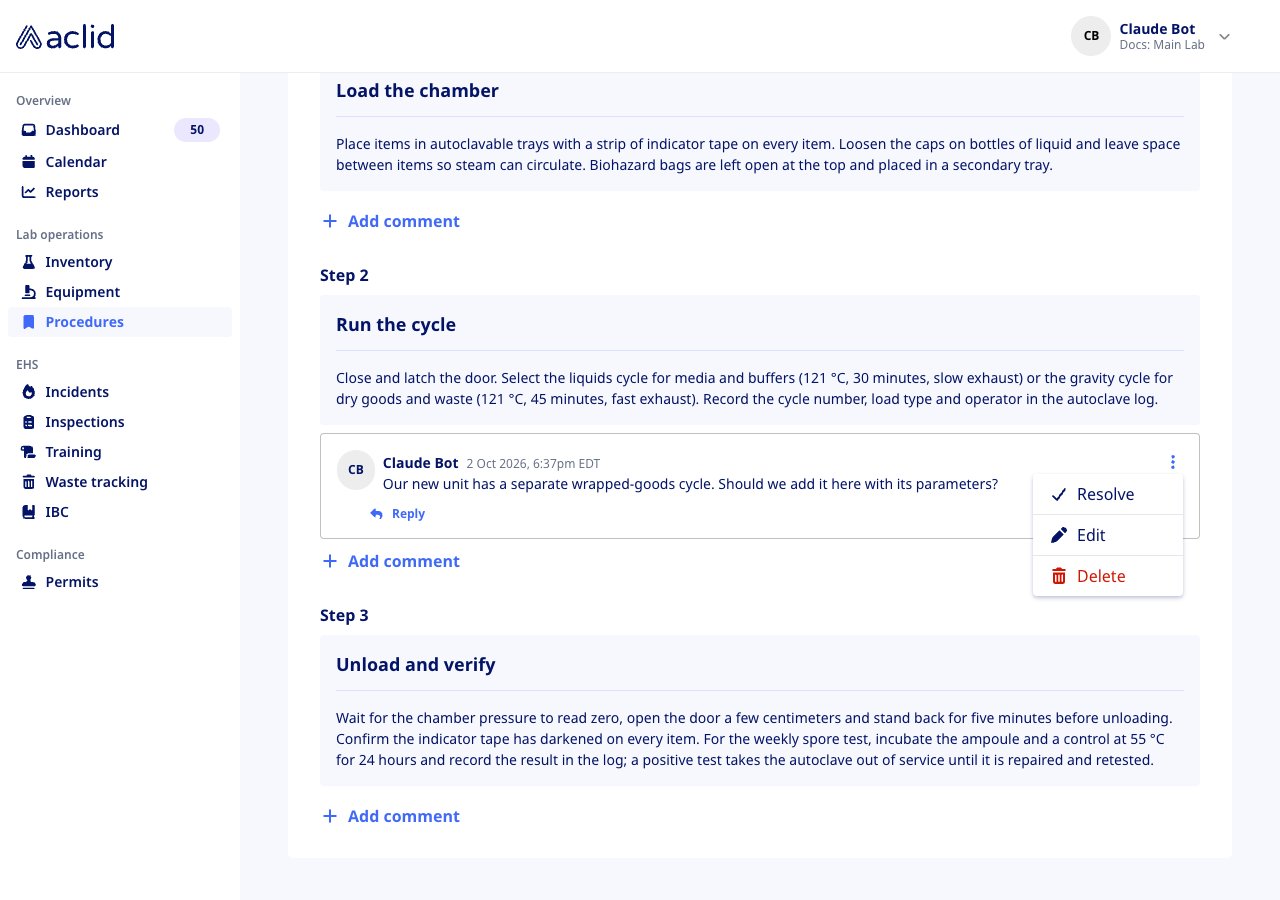
An open comment on step 2, with the author's menu
Create a policy and attach its document
Admins only.
- Switch to the Policies tab and click +. In Create policy enter a Name, optionally a Description (optional) and, in a multi-site organization, Site access, then click Create.
- On the policy page click Upload in the Policy card and drop the PDF (Upload or drop PDF). Replace swaps it later and View opens it in a new tab.
- Edit on the Overview card changes the name and description; Edit on Policy author picks a member whose phone, email, title and department are then shown.
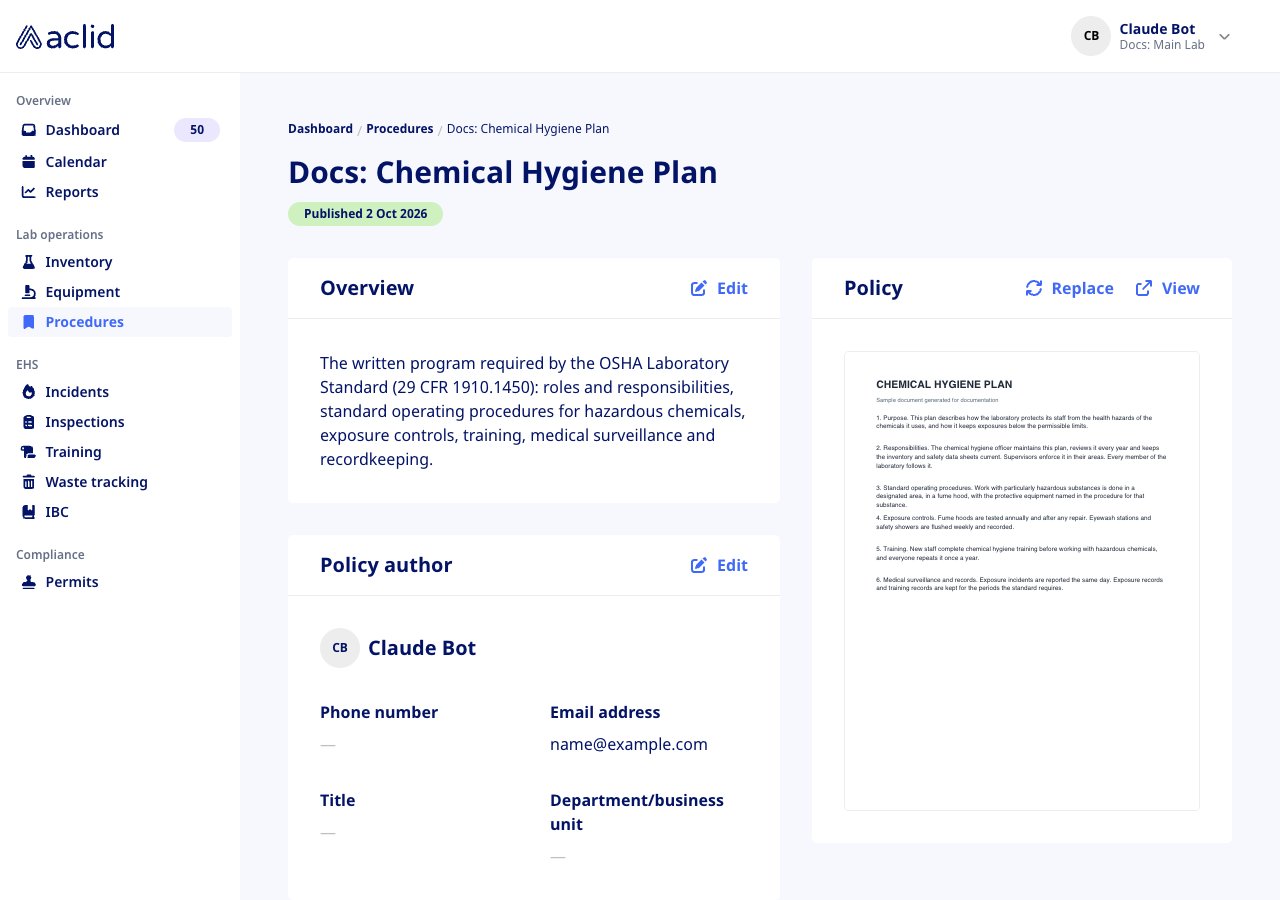
A published policy with its document
Limit a protocol or policy to certain sites
Admins only, and only admins who are not themselves limited to a site.
- In a multi-site organization the page shows a Site access card listing the sites, or All sites.
- Click Edit, choose the sites in Edit site access and click Save. Leaving the selection empty makes it available at every site. The restriction belongs to the protocol, not to one version.
Reading the list
- Version: the version each row is, as v1, v2. Each protocol appears once for its latest published version and, for admins while one exists, once more for its draft; earlier published versions are reached from the version picker on the protocol’s page.
- A speech-bubble badge before the Name counts the open comment threads on that version.
- Tags: the protocol’s tags; the chips above the table filter by them and show how many protocols carry each.
- Site: shown while every site is in view. All means unrestricted; several sites read as 2 sites.
- Status, Author, Last updated: Published (green) or Draft (grey), the credited author, and when the version last changed. The row menu offers Details.
- The Policies tab lists Name, Site, Author and Last updated; it has no status column, and members simply do not see drafts.
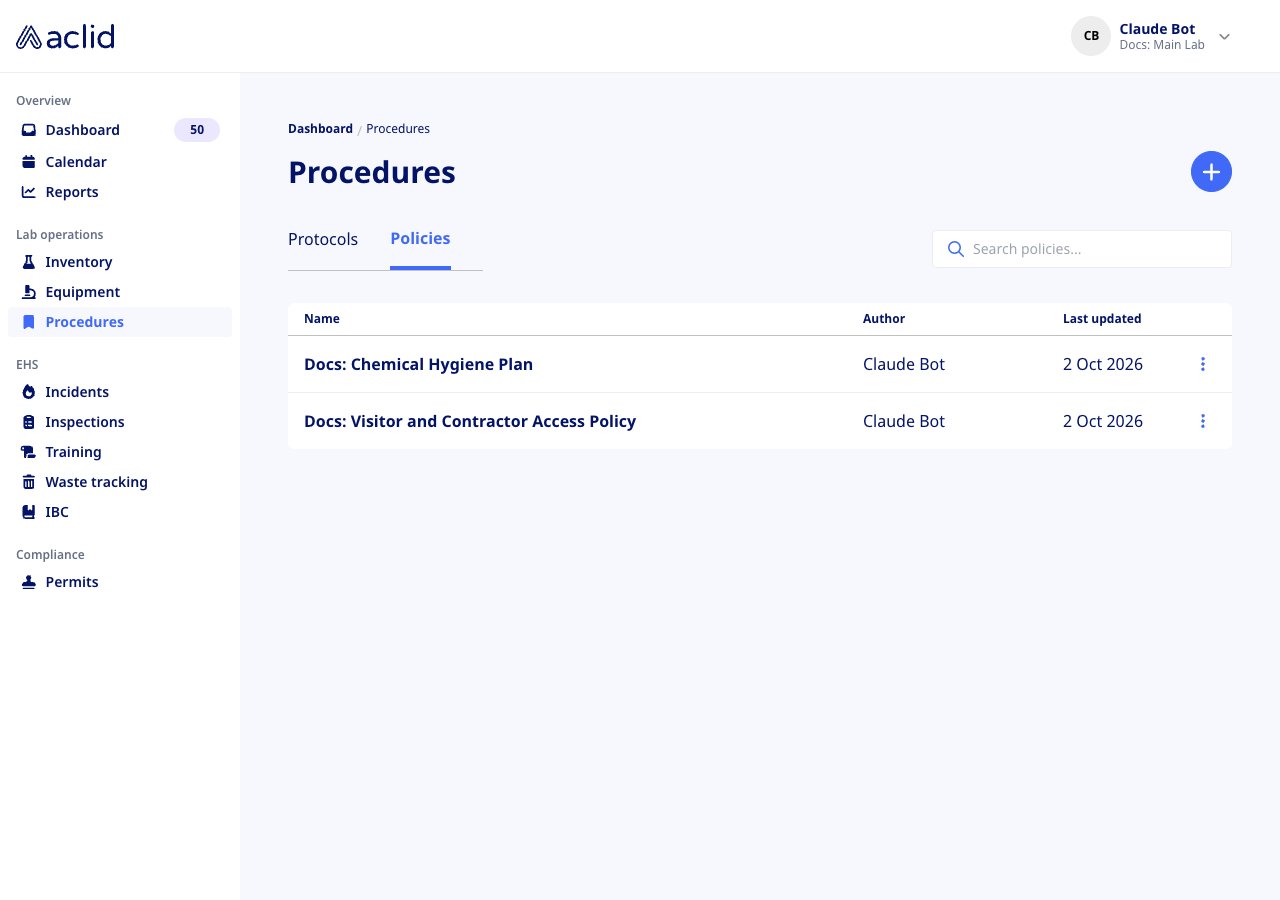
The Policies tab
Tips and limits
- Search matches the name or description and runs separately for each tab; Clear search restores the list.
- Members only ever see published versions, in the list and by direct link. A protocol with no published version is invisible to them.
- Comments belong to one version. Publishing a draft or starting a new one does not carry threads across, and replies cannot be replied to.
- Protocol files and policy documents are limited to 25 MB. Protocol files can be PDF, Word (.docx), video (.mp4, .webm, .mov) or spreadsheet (.xlsx, .csv, .numbers); policies take PDF only.
- Policies have no Publish control in the app. A policy created here stays a draft, visible to admins only, until it is published for you.